
Know-how
Data first, then AI
AI amplifies what is already there. Start with unclear processes and spreadsheets, and you only get more mess, faster.
In many conversations with owners of small businesses the same hope comes up at the moment: an AI agent is supposed to take the load off the office. The idea is not wrong. But it usually skips a step, and that step decides whether anything useful comes out in the end.
AI is an amplifier, not a shortcut
An AI makes more out of what you give it. Put in good, structured data and useful results come out. Put in unstructured data and all you get is more mess, faster. The old principle from data processing still applies, just with more leverage.
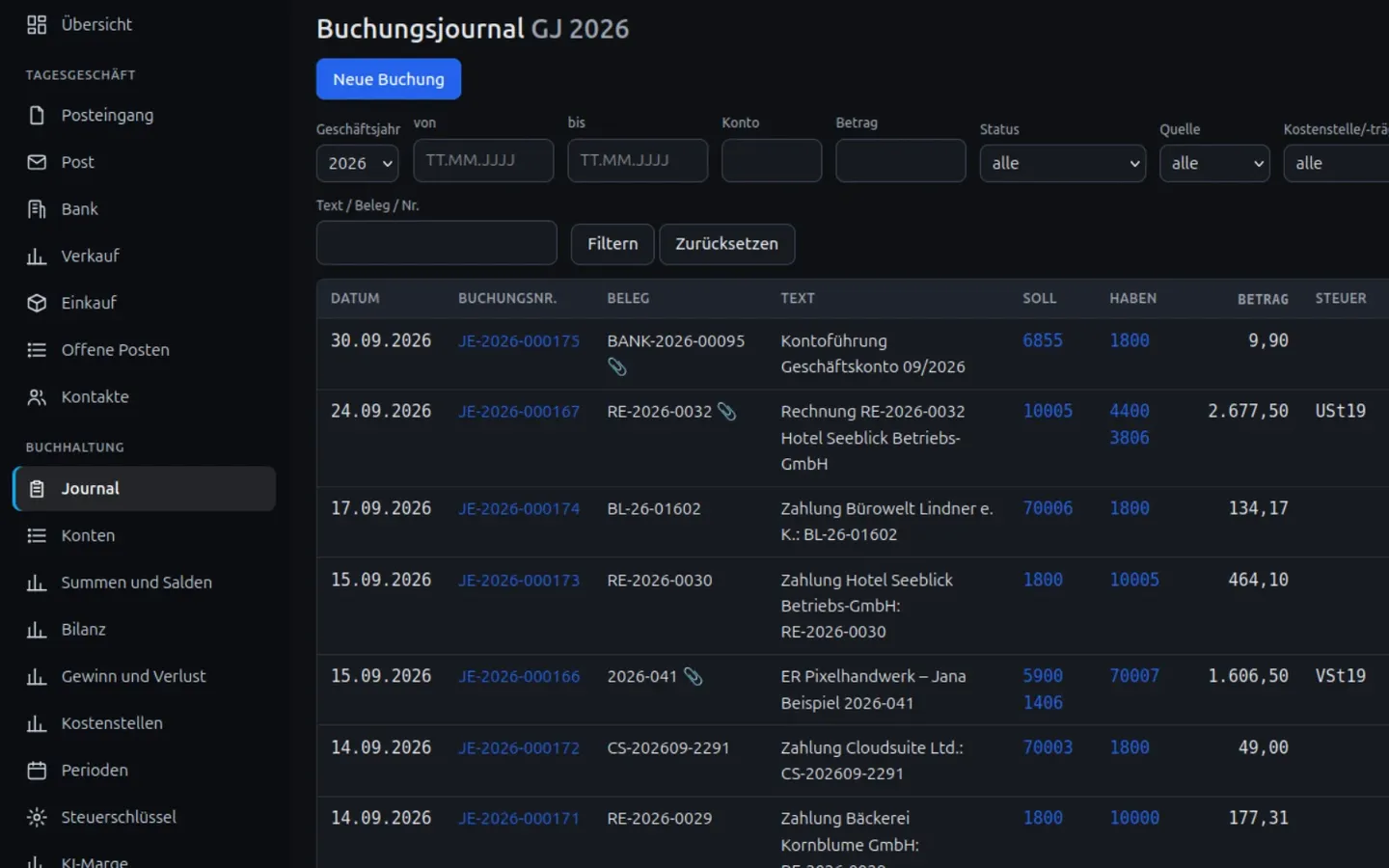
In small businesses the starting point often looks like this: customer data in a spreadsheet, quotes in Word files, appointments in one employee's calendar, and the most important knowledge in the owner's head. Each of these places works on its own. Together they do not form a data basis that an automation can build on.
The order that has proven itself
My projects have settled into an order that I no longer shortcut:
- Define the data basis. What is being represented at all? A customer, an order, a receipt, an appointment. Where is it stored, who may change it, how does it stay findable?
- Build the data model. The things get a fixed structure and relationships to each other. An order belongs to a customer, a receipt to an order.
- Describe the processes. Who does what, when, with which inputs and which result? That sounds trivial and is the step most often missing.
- Digitise. The described process runs in software, at first still operated by hand.
- Automate. The system takes over the routine steps.
- Human in the loop. Wherever something goes out or costs money, a person checks and decides.
- Observe. Logs, evaluation, error rate. Only when that is stable does more automation come into question.
In this order, AI only appears from step five onwards. And even there only where it can do something a normal algorithm cannot: understand free text, classify photos, turn unstructured input into structured suggestions. Where a simple rule is enough, I use the rule. It is cheaper, faster and explainable.
Why Excel is not enough for this
I have nothing against spreadsheets. For an evaluation or a short list they are the right tool. As the knowledge store of a business, though, they are not enough, and they certainly do not scale: there are no fixed relationships between things, no check whether an entry is valid, no history of who changed what and when, and no clean interface through which another program could read the data. Any automation that sits on top of such a spreadsheet breaks at the first renamed column header.
What this means for small businesses
The good news: the data basis of a small business is manageable. This is not a corporate project, but a handful of things that need to be stored properly. Often a small tool is enough, one that keeps customers, orders and receipts in one place and talks to the existing programs. From there you can build step by step, with or without AI.
Those who skip this foundation and set an agent loose on the mess straight away will very probably be disappointed. Those who lay it end up not just with an automation, but with a business whose processes can be traced. Where AI makes sense after that, and how I build it in, is described under AI with approval.