
Devlog
Voxel Dynasties: an old dream, block by block
Devlog on my real-time strategy game. Why an RTS is so hard for a solo developer, and what a game teaches business software.
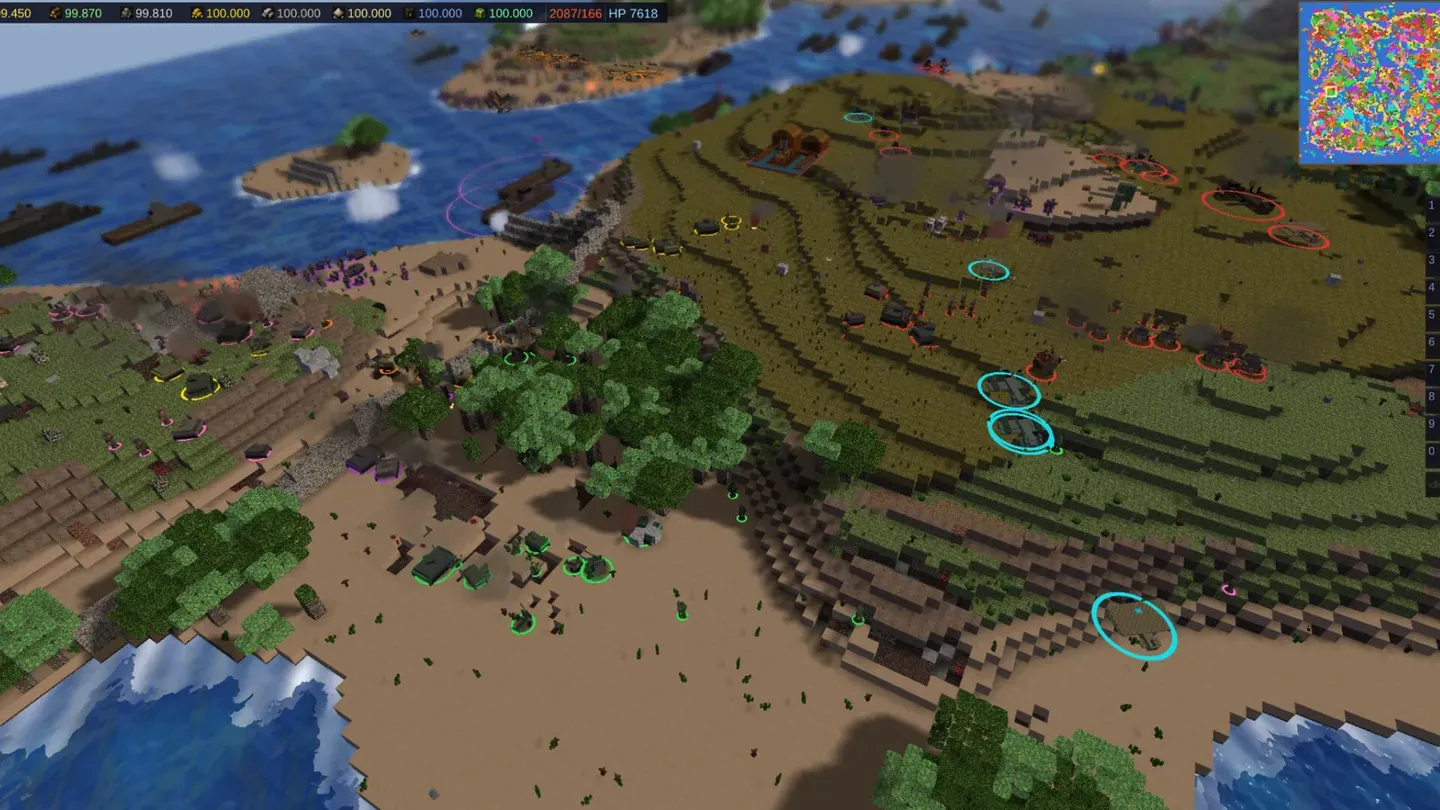
As a child I spent countless hours with Age of Empires. At some point the question came up that has never let go of me since: how do you actually make something like that? That is exactly where programming got hold of me. And ever since there has been a quiet dream: a real-time strategy game of my own. A proper one, with multiplayer, real units, opponents that fight back, ages, navy and air force.
The problem: a strategy game of this kind is among the most complex tasks a software developer can take on. So for a long time it stayed a dream.
Why this is so hard for a solo developer
A few of the construction sites such a game brings with it:
- Deterministic multiplayer. All players run the same simulation in parallel; only the commands are transmitted. If a single intermediate result differs, say through a rounding difference, the match drifts apart.
- Pathfinding for land, water and air, for thousands of units at once, without the simulation stalling.
- A procedurally generated world with continents, coasts, rivers and highlands, different every time and still playable.
- An entity component system that manages thousands of units without the code turning into a knot.
- Opponent AI that does not just build, but answers the player's strategy with a counter-strategy.
- Ten ages from the Stone Age to the Atomic Age, each with its own units, buildings and technologies.
Each of these tasks is a project in its own right. Together they are the reason such games are normally built by teams over years.
What came of it
Voxel Dynasties is by now a playable game. An engine of my own in Java, a world made of blocks in which every fortress can fall stone by stone, lockstep multiplayer, navy and air force, and a mode in which you take over a single unit in the middle of the battle and control it from its point of view. The implementation went much faster than I would have trusted myself to manage earlier, partly because I work with AI support on the implementation and can concentrate on architecture and decisions.
The moment a match first ran against an opponent AI that really countered was one of the most satisfying in my career as a developer. The game is still in development; a free demo is available on Steam.
What a game teaches business software
You might think a strategy game and an order management system have nothing to do with each other. Technically, though, they demand the same things:
- Clean architecture. If simulation, rendering and networking are not clearly separated, none of them can be changed without damaging everything else. The same applies to an application with users, receipts and interfaces.
- Automated tests. Deterministic multiplayer can only be kept reliable with tests. So can an accounting system or a receipt workflow.
- Reproducible builds. The version on Steam has to be exactly the one that was tested. The same goes for the application running at a client's.
The experience from complex real-time software therefore flows directly into the business applications I build: clear system boundaries, tests and a delivery that runs the same way every time. More on the game, with pictures and the link to the demo, is in the portfolio under Voxel Dynasties.