Portfolio · Own product · Planning solution · 2026
Route planning for field teams
Jobs, time windows and emergencies assigned to the vans automatically, calculated over real roads. Runs on a small server in Germany and is only reachable through an encrypted tunnel.
- −14 %kilometres on the sample day: 140 instead of 163 km
- 0 instead of 3missed customer time windows
- 16:51instead of 20:01, the last technician is back
The problem
Anyone who sends several people to several jobs a day usually plans by hand in the morning: split the area, appointments with a time window first, then always the nearest customer. That works as long as every area is equally busy. When it is not, one person spends the evening in the van, customers wait, and a morning emergency throws the whole plan over.
That costs kilometres, overtime and annoyed customers every day. And it depends on the one person who has the planning in their head.
The solution
A small web application that turns the day's job list into proposed routes:
- Jobs in: address, estimated duration, the customer's time window, urgent or not. Typed in, as an Excel list or straight from your software.
- Proposal out: the computer tries tens of thousands of variants and keeps the one with less driving, no missed appointments and as little overtime as possible.
- You keep the last word: if a customer wants a particular technician, move the job and the rest is recalculated.
- Emergency: a click on the map and the routes rearrange. You see at once who should take it and what it costs.
- On the road: everyone sees their day on the phone, job by job.
Routes are calculated over the real road network from OpenStreetMap, with driving speeds per road type and time for parking. No outside routing service gets your customers' addresses.
Transcript
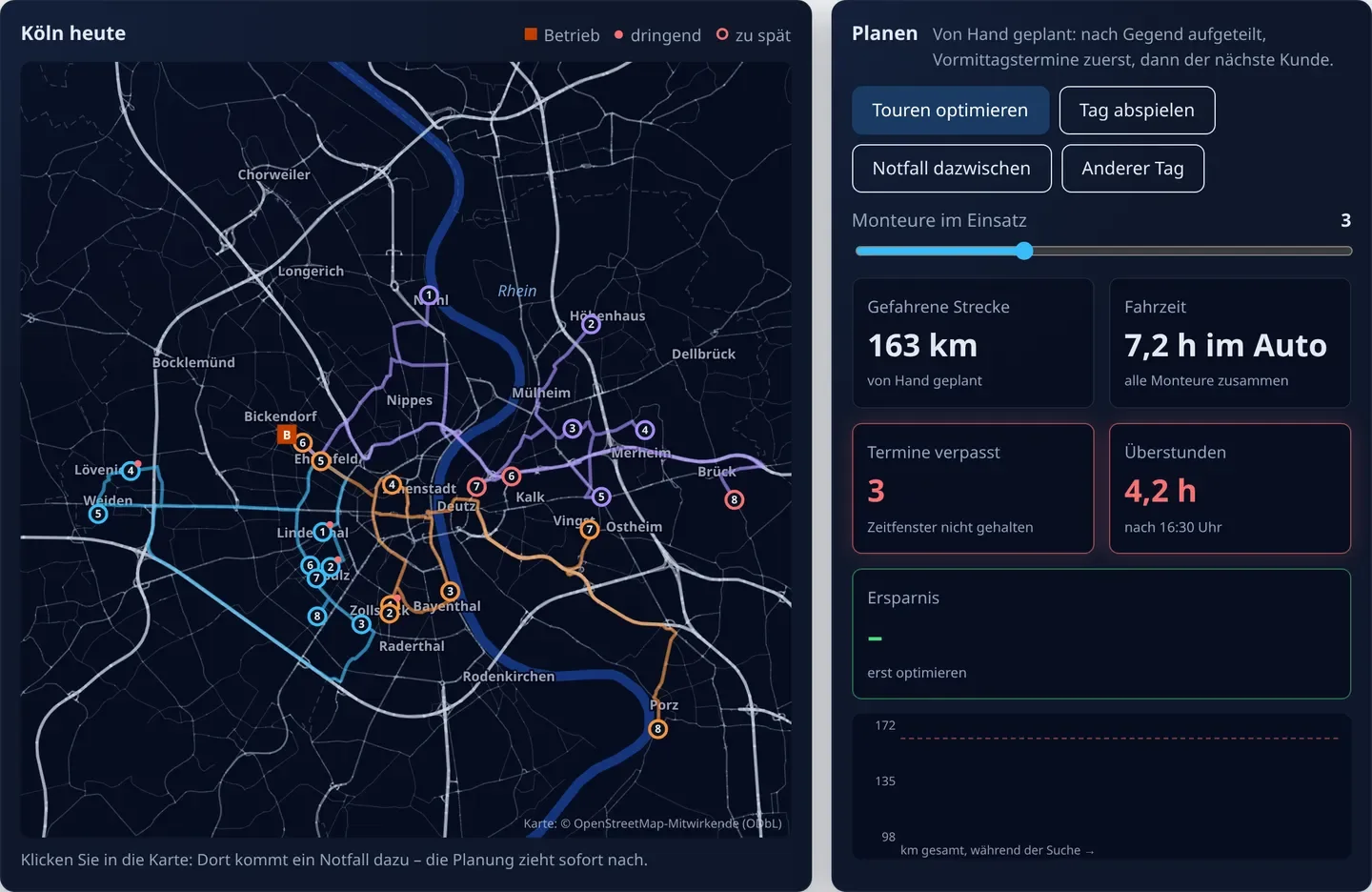
1. 7 a.m. at a heating installer in Cologne: 24 jobs pile up, three technicians. By hand: split the city, mornings first, then the nearest.
2. Routes by hand on the real map of Cologne: 163 km, 7.2 h in the van, 3 missed appointments, 4.2 h overtime. Note: demo, real map (© OpenStreetMap contributors), made-up jobs.
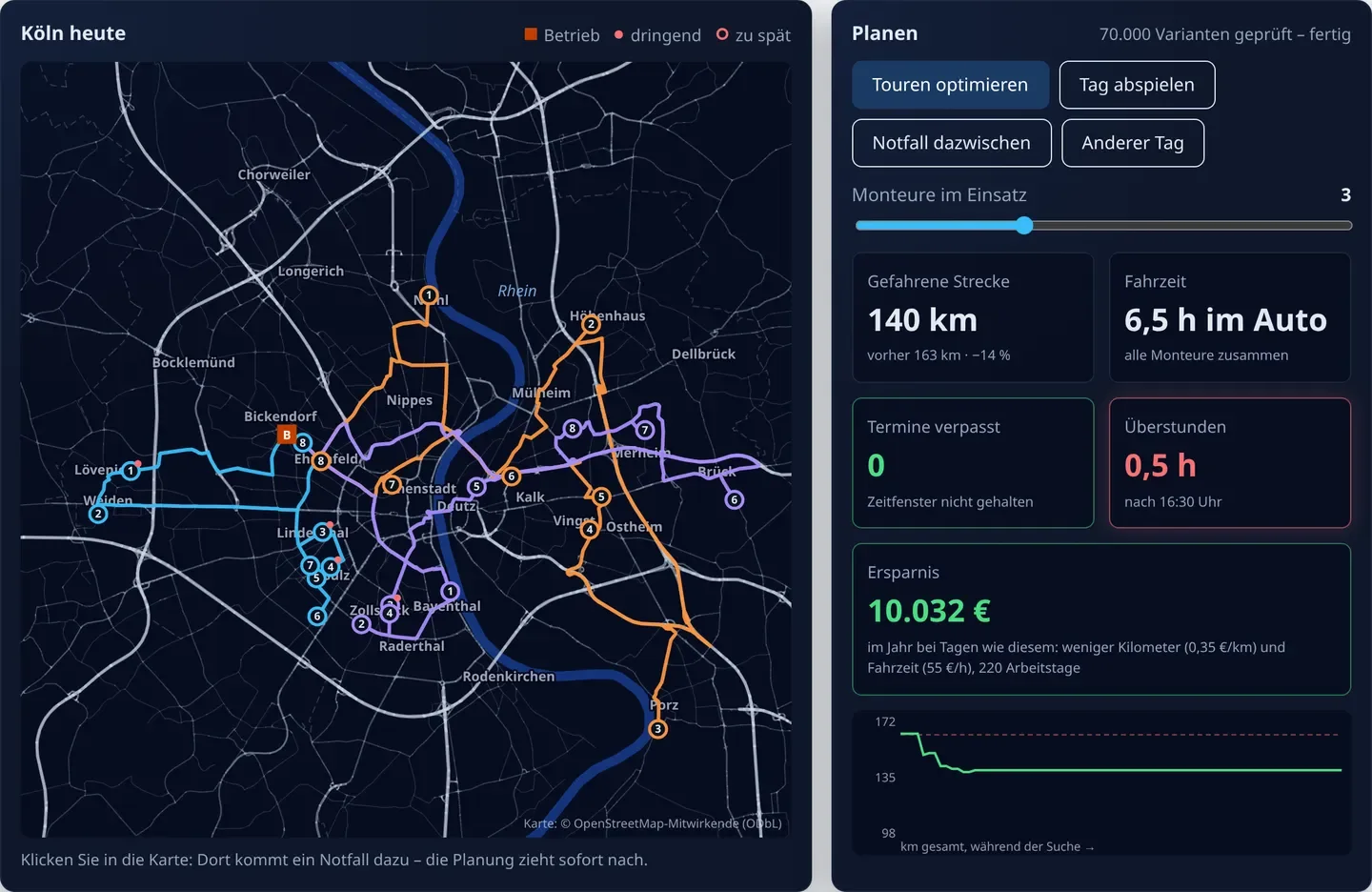
3. The computer moves, swaps and reverses: 70,000 variants, the kilometres drop.
4. Same jobs, better routes: 140 instead of 163 km (−14 %), 6.5 instead of 7.2 h, 0 instead of 3 missed, 0.5 instead of 4.2 h overtime.
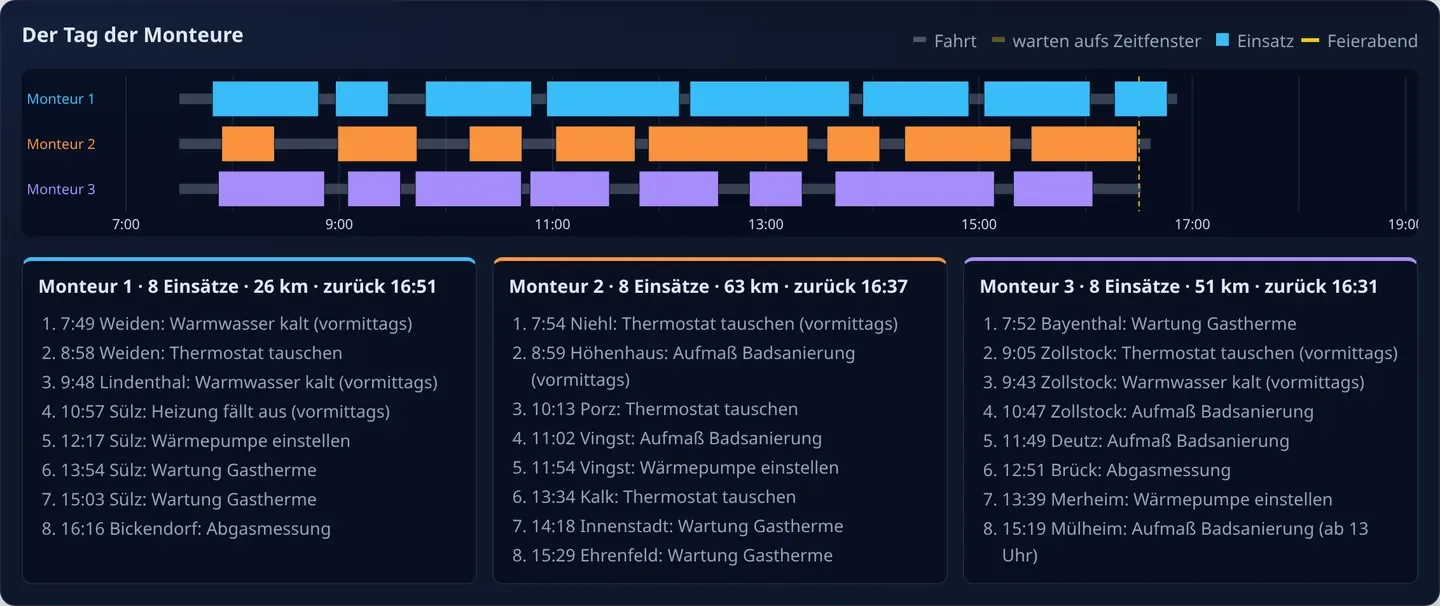
5. The day plays out: vans on real streets, a timeline per technician.
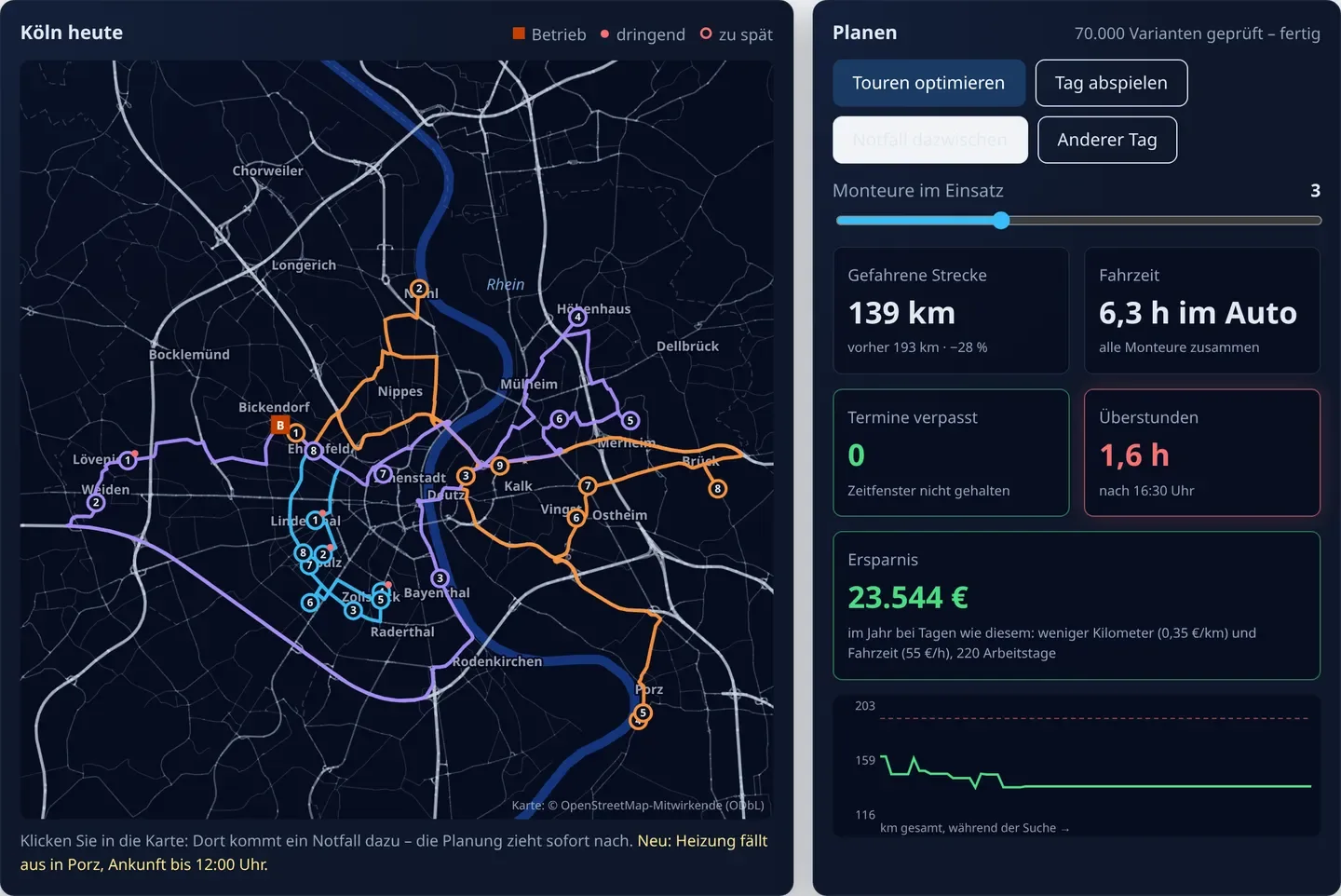
6. Emergency in Porz, arrive by 12:00. Just added at the end: 5 h 21 min late. Re-planned: on site at 10:25, nothing missed.
7. €10,032 per year on days like this.
8. Planning by hand: hours. Checking a proposal: minutes.
9. Where do your people drive too much? fk-onlineservices.de
What it brings: a sample day
I worked the solution through on a typical service day: a heating company in Cologne, 24 jobs from maintenance to a broken boiler, three technicians. Map and roads are real, the jobs are invented.
| By hand | Proposal | |
|---|---|---|
| Distance driven | 163 km | 140 km |
| Missed appointments | 3 | 0 |
| Overtime | 4.2 h | 0.5 h |
| Last technician back | 20:01 | 16:51 |
Projected with open assumptions (€0.35 per kilometre, €55 per hour of driving, 220 working days), days like this add up to around €10,000 a year, not counting the overtime avoided. How the computer gets there, step by step, is described in the article Route planning: how the computer plans the routes for three technicians.
Fits many businesses
The pattern is the same wherever people visit several addresses a day:
- Trades and customer service: heating, plumbing, electrical
- Home care and nursing services
- Maintenance, cleaning, caretaking
- Delivery services and beverage wholesale
- Field sales and service reps
What gets adapted is what makes your business different: skills (not everyone may work on a gas boiler), regular customers per employee, breaks, vans with a load. What the solution needs you usually have already: addresses, an estimated duration per type of job and the time windows you promise.
Small to run, safe to reach
The application needs no data centre. A small virtual server in Germany is enough for a business with a handful of vans; map and road network live on the same server.
Your people reach it from the office laptop, the tablet or the phone in the van, through an encrypted tunnel (VPN). On the device that is a small app: set up once, then a switch.
| Protection | What it means |
|---|---|
| No open login page | The application has no public address. Anyone outside the tunnel sees nothing to attack. |
| One key per device | Every device gets its own key. If a phone is lost, exactly that key is blocked and everyone else keeps working. |
| Encrypted twice | The tunnel is encrypted, and so is the connection to the application inside it. |
| Sign-in and roles | Everyone signs in personally. Technicians see their day, the office plans. Failed attempts are limited. |
| Server sealed off | A firewall only lets the tunnel in. The server itself is maintained only through the tunnel and only with a key, never a password. Security updates install automatically. |
| Backup and monitoring | Data is backed up every night and kept encrypted away from the server. Whether the application is running is checked every five minutes. |
| No tracking of your people | Planning works with addresses, time windows and durations, not with locations or the performance of individual employees. |
How to get there
- Try it: the route planning runs as a showcase with the Cologne sample day, including your own emergency by clicking the map. Get access via Request access.
- Run your numbers: send me one real day of your jobs, without customer names. I calculate it and you see what changes for you.
- Your own application: adapted to your business, in stages at a fixed price, running on your own small server. Cost and process are described under Route planning.