Portfolio · Own product · Planning solution · 2026
Staff planning by forecast
Till data, weather, public and school holidays become a forecast of demand, and the forecast becomes a proposed rota. Runs on a small server in Germany and is only reachable through an encrypted tunnel.
- 355 instead of 435staff hours in the sample week
- ± 12 %deviation per day, tested on 26 unseen weeks
- €1,680less wage cost in one week
The problem
Next week's rota is often made on Sunday evening: a look at the weather forecast, the bookings, maybe last year, then shifts by gut feeling. Or every day gets the same staff.
Both cost twice. On a warm Friday evening people are missing and guests or customers wait. On a rainy Tuesday too many stand around and the wages run anyway. Nobody keeps weekday, weather, holidays, school breaks and events in their head at the same time.
The solution
A small web application that learns from your own figures when it gets busy, and proposes the rota from that:
- Learning from your data: till receipts or turnover per hour, bookings or appointments, ideally from one or two years. Weather, public holidays and school breaks come from public sources.
- Forecast per half hour: a small neural network predicts how many guests or customers will come next week, day by day like a weather forecast.
- Demand by your rules: how many guests one server looks after or how many meals the kitchen manages per hour is up to you.
- Proposed rota: continuous shifts with a minimum length, split shifts too. The proposal names roles, not people. Who works is your decision.
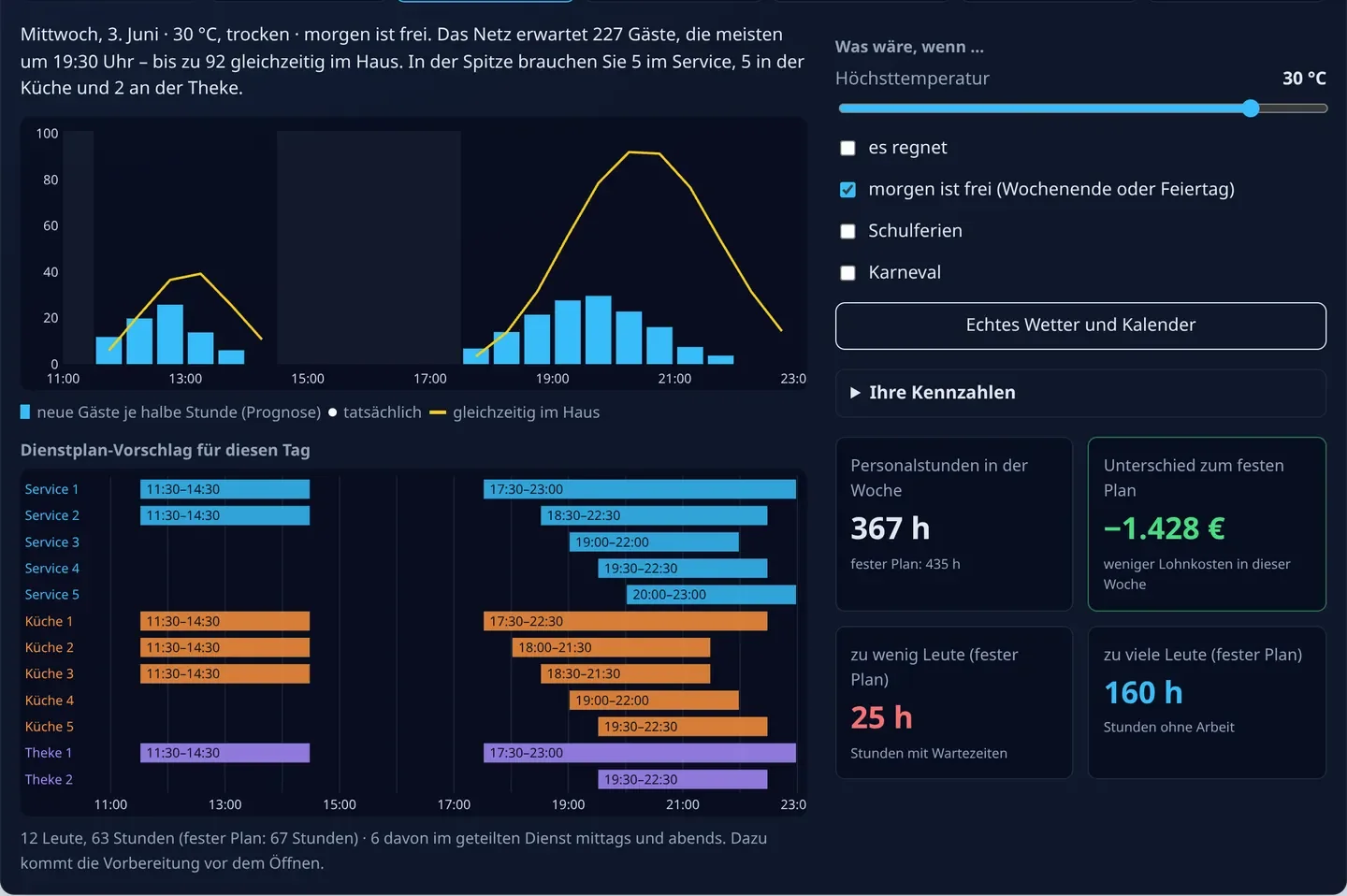
- What if: if the weather forecast changes on Thursday, Saturday's plan recalculates and you see whether someone else should come in.
Transcript
1. Sunday evening in a Cologne restaurant: an empty rota fills with question marks, then the same every day: 4 service, 3 kitchen, 1 bar. Warm Friday: too few staff. Rainy Tuesday: too many.
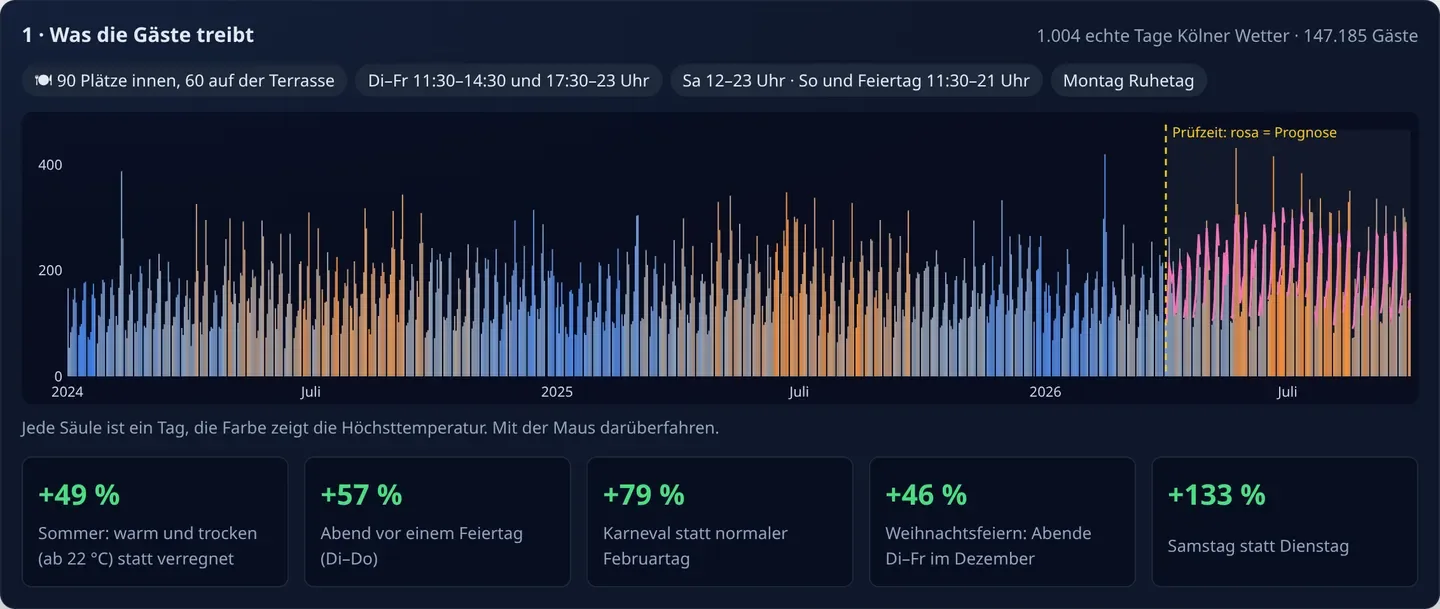
2. 1,004 real days of Cologne weather as bars coloured by temperature, plus holidays, carnival and Christmas parties. Note: demo, real weather, made-up guests.
3. A network learns in 30 epochs. Error per day: ± 12 %, tested on 26 unseen weeks.
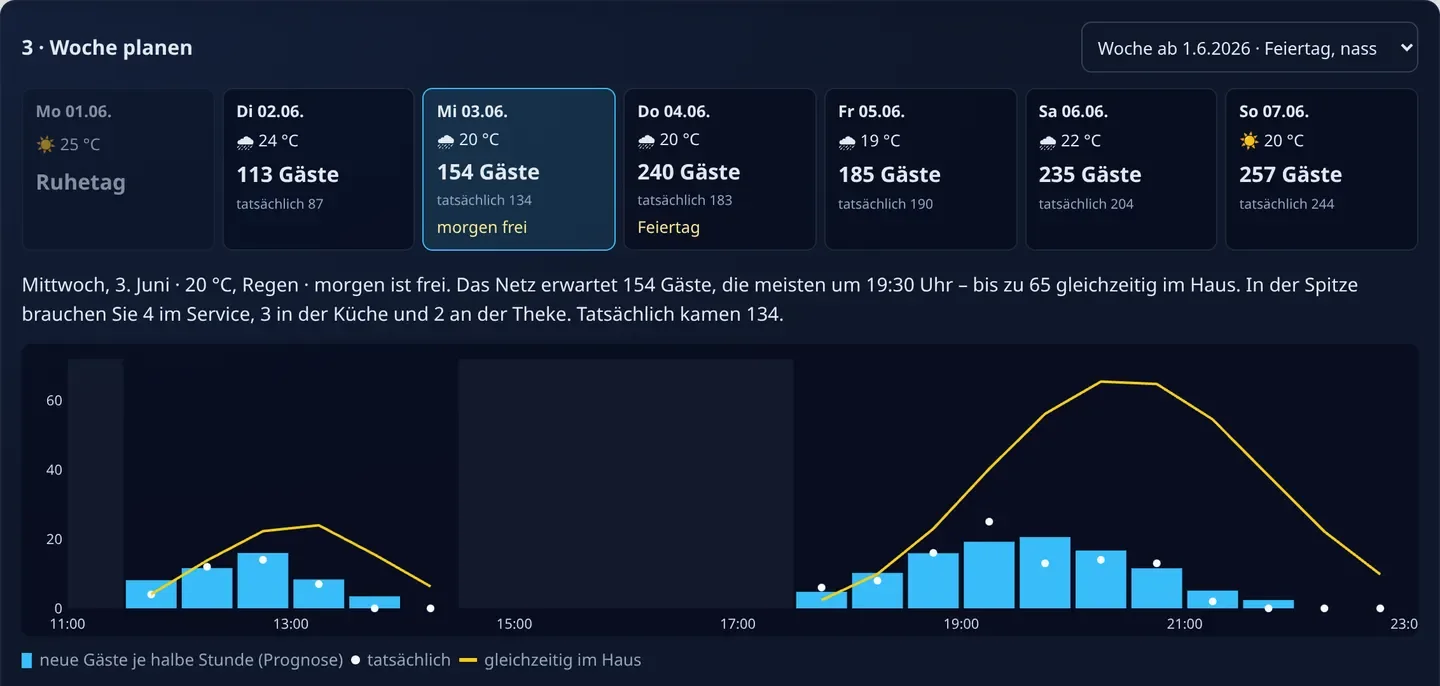
4. Forecast for the week of 1 June 2026; the Wednesday before Corpus Christi: 154 guests.
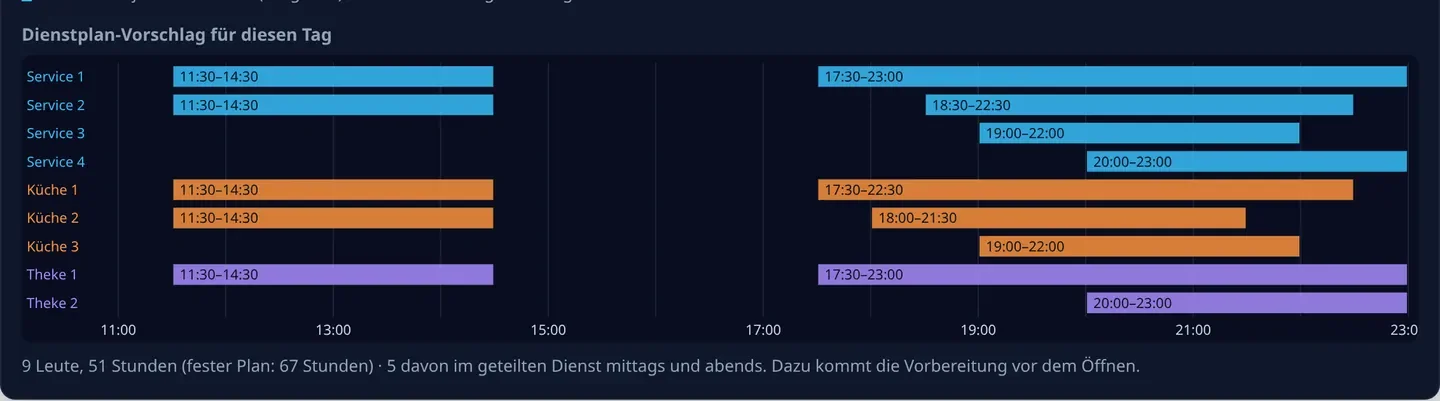
5. This becomes a rota: 9 people, 51 instead of 67 hours.
6. The whole week: 355 instead of 435 hours, €1,680 less wage cost.
7. What if the sun comes out: 227 guests, 12 people, 63 hours.
8. Planning by hand: hours. Checking a proposal: minutes.
9. Which planning eats your time? fk-onlineservices.de
What it brings: a sample week
I worked the solution through for a restaurant with a terrace in Cologne. It is based on 1,004 real days of Cologne weather with the real public and school holidays of North Rhine-Westphalia; the guest numbers are invented.
| Fixed plan | With forecast | |
|---|---|---|
| Staff hours in the week | 435 | 355 |
| Wage cost at €21 per hour | €9,135 | €7,455 |
| Wednesday before the holiday | 67 hours | 51 hours, 9 people |
More than the saving, what counts is where the staff are: the fixed plan had 164 hours with people standing idle and 21 hours with people missing. How the network learns and how accurate it is is described in the article Staff planning by guest forecast: how a network proposes the rota.
Fits many businesses
The same pattern works wherever demand varies and staff are planned around it. Instead of guests, other things are counted per half hour:
- Restaurants and hotels: guests, overnight stays, breakfasts
- Retail and bakeries: customers at the till
- Medical and therapy practices: patients and appointments
- Call centres and customer service: calls and requests
- Leisure pools, cinemas, workshops: visitors or jobs
Before you commission anything, I check on a sample of your data how well your business can be forecast.
Small to run, safe to reach
The application needs no data centre. The network is small enough to learn and calculate on a small virtual server in Germany. Your figures do not leave that server.
It is reachable from the office PC, the tablet in the kitchen or the phone, through an encrypted tunnel (VPN). On the device that is a small app: set up once, then a switch.
| Protection | What it means |
|---|---|
| No open login page | The application has no public address. Anyone outside the tunnel sees nothing to attack. |
| One key per device | Every device gets its own key. If someone leaves or a phone is lost, exactly that key is blocked. |
| Encrypted twice | The tunnel is encrypted, and so is the connection to the application inside it. |
| Sign-in and roles | Everyone signs in personally. Whoever plans sees forecast and cost, everyone else only what they need. Failed attempts are limited. |
| Server sealed off | A firewall only lets the tunnel in. The server itself is maintained only through the tunnel and only with a key, never a password. Security updates install automatically. |
| Backup and monitoring | Data is backed up every night and kept encrypted away from the server. Whether the application is running is checked every five minutes. |
| No employee data in the forecast | It works with guests or customers per half hour, not with the performance of individual people. |
How to get there
- Try it: the staff planning runs as a showcase with the Cologne restaurant, including the what-if. Get access via Request access.
- Check with your figures: send me a sample of your till or appointment data. I check how well your demand can be forecast before you commission anything.
- Your own application: adapted to your business, in stages at a fixed price, running on your own small server. Cost and process are described under Staff planned to demand.